Tuesday, March 5, 2013

It's Easy to Do (#32: The Break-Up)


#32: The Break-Up

The Break-Up may be the weirdest Hollywood romantic comedy of all time. It doesn't shy away from its title at all. It really is about a break up. An awkward, uncomfortable, protracted break up. For that, it deserves credit, because its a pretty brave and bold inversion of what the viewer expects. But there's a reason romantic comedies don't usually feature two people who don't seem to like each other.
 
Besides a short prologue showing the meet cute between our leads, Vince Vaughn and Jennifer Aniston, at a Cubs game, there's almost nothing to establish these people as an actual couple. Sure, there's a dinner party with their respective families (including very funny supporting turns by John Michael Higgins and Vincent D'Onofrio (yes, him!) that almost feel like they're from a different, broader movie). But immediately after that dinner, we have a historic and realistic row between the two - an argument that is viscerally acted and plays out unrelentingly in real time. The upshot of the fight is (you guessed it), a break up. Problem is: these two co-own a pretty killer Chicago condo and neither wants to give it up. Also: maybe, okay, yeah, they still have feelings for each other a little bit. So they break up but keep living together while kinda sorta dating other people, which works out about as well you expect. A series of misunderstandings and things left unsaid eventually drives them further and further apart and they really, truly break up.
 
There's an ambiguous run in between the two at the end that suggests maybe the spark could be rekindled. But (admirably) the film leaves it at that.
 
A few weeks ago, there was a story on This American Life about a couple that had been together since they were in college. Turning 30 and thinking about marriage, they decide to put it off for 30 days so that can sleep with some other people for the first time. They called it their "rumspringa." 30 days turns into 60, then 90, and then they go their separate ways. Towards the end of the interview, the guy being interviewed suggests that if he ever gets married, he would want to have the marriage either renew and void every seven years to make sure both are still in. Ira Glass recoils at that and makes a great point:
I don't know what I think of that. Because I think, actually, one of the things that's a comfort in marriage is that there isn't a door at seven years. And so if something is messed up in the short-term, there's a comfort of knowing, well, we made this commitment. And so we're just going to work this out. And even if tonight we're not getting along or there's something between us that doesn't feel right, you have the comfort of knowing, we've got time. We're going to figure this out. And that makes it so much easier. Because you do go through times when you hate each other's guts. You know what I mean?

Watching The Break-Up again, this statement feels very, very true. The fights in this movie feel like fights we've all had with each other over the years (notice the use of the royal "we" here: I, of course, never fight with my beloved and adored better half). The reason Vaughn and Aniston don't make it work here is because they have an out. They don't say the things they would say to patch things over or smooth things out if they felt compelled to make it work. So they end up passing each other (CLICHE ALERT) like ships at night, over and over.
 
It's an interesting movie. Occassionally funny. Honest in its intra-couple vitriol. Tonally, a little all over the place. Worth watching once or twice. But not worth owning. In fact, I have no idea why or when we bought it.
 
FINAL VERDICT: PITCH
 
NEXT UP: BRIDESMAIDS

Monday, March 4, 2013

I Loves Ma Gun (#31: Bowling for Columbine)

Michael Moore made himself famous with his first documentary, Roger & Me, a devastating look at how GM singlehandedly destroyed his hometown of Flint, MI. (SPOILER ALERT: Don't watch if you love rabbits). Since then, Moore has brought his schlubby blue collar persona and wry sense of despair and moral outrage to address some of the biggest issues of our time, to greater or lesser effect (your mileage may vary). Whether you love Michael Moore or hate him tends to accord with your personal ideology, but his skill as a filmmaker can't really be questioned. He basically invented the modern political documentary

Also, he made the video for Rage Against the Machine's best song (IMHO), so he's got that going for him:


In our thirty-first film, Moore takes on America's obsession with guns. Ostensibly inspired by the worst act of school violence in our history (well, at least, prior to the recent tragedy at Sandy Hook Elementary), Bowling for Columbine asks over and over again: what is it about America and Americans that makes us kill each other with guns at such incredibly high rates?

I say "ostensibly" because while the movie is framed as if it's about Columbine and what caused it, Moore spends precious little time considering that particular tragedy. There is a haunting and powerful segment featuring surveillance footage of the attack - with 911 calls from frantic parents and students as the only soundtrack. And a sequence featuring two Columbine survivors "returning" the bullets embedded in their bodies to K-Mart headquarters in Troy, MI. But Moore quickly moves outside the narrow scope of Littleton, CO to consider gun violence in America generally.

Note to self: Do not cross this dog.
Moore's exploration of that subject is intriguing, frequently hilarious, but at the same time maddeningly diffuse. There's a lot here that feels true about the violence in our culture: (a) our increasingly violence-on-demand foreign policy (represented by bombings and installing dictators by Moore, but one can't help but think drone attacks today); (b) our long fraught history of white supremacy and racial tension; (c) a commercial culture based on fear (articulated succinctly and persuasively by Marilyn Manson, of all people); (d) anti-government militia movements; (e) a high school culture that lets lost souls get lost; (f) welfare to work programs that are taking parents from their kids; and (g) an out of control and insanely well-funded NRA. But the whole is less than the sum of its parts. In the moment, whatever Moore is exploring at the time seems a convincing explanation, but then we're whiplashed into some other explanation that doesn't really cohere or seem relevant to the specific example of Columbine. 

The best example of this is probably Moore's comparison of the US and Canada. Both countries are similar culturally and have a huge ratio of guns to population. But there's almost no gun violence in Canada. In an amusing sequence, Moore illustrates how much safer Canadians feel by walking into the unlocked homes of unsuspecting Torontoans.* When someone suggests that greater racial homogeneity in Canada might explain the difference, Moore immediately swats that down with hardly a comment. BUT he's just spent a big chunk of Bowling for Columbine's running time (including a South Park-esque cartoon history lesson) talking about how racial tension in the US might lie at the root of our gun culture! That quick refutation of his own argument just confuses me to this day - especially when his film closes on a befuddled NRA President Charlton Heston essentially admitting (and instantly wishing he didn't) that we white people need our guns to keep the less desirables at bay.# I don't think that's a terribly persuasive explanation for why we kill each other like crazy, but its an interesting enough argument that you either need to really make it or tear it apart. (Side note: Does anyone know if the NRA being founded the same year the KKK was outlawed is anything other than mere coincidence? It's an interesting tidbit Moore drops without (maddeningly!) really following up on).

That lack of focus and the episodic nature of the film ultimately leaves the viewer a little lost on the point of it all. It doesn't sap the effectiveness of some of the individual moments, especially a disturbing and transfixing interview with James Nicholls - brother of Oklahoma City co-conspirator Terry Nicholls (I'd like to see that interview extended into a feature of its own). But, at the end, I was left a little cold. (And, while I'm sympathetic generally to Moore's point of view, the self-mythologizing man of the people in oversized fishing cap schtick feels a little hackneyed after all these years.)

All the same, Amelia has used individual clips from this teaching, so we plan on keeping it for educational purposes only.

FINAL (MIXED) VERDICT: PITCH for Home but KEEP for School.

NEXT UP: THE BREAK UP.

*Also hilarious: The Canadian woman who boasts about not locking her doors, despite having her home broken into twice. Dear Canadian Lady, Take the hint and buy a deadbolt. Sincerely, Cynical American. 

#Heston ironically says this in front of a Touch of Evil poster, wherein he is famously (mis)cast as a Mexican cop.

Tuesday, February 26, 2013

A Happy Premise (#30: Bowfinger)

Long before PT Anderson ruffled thetans with The Master, even before South Park did its infamous "This is What Scientologists Really Believe" episode, Steve Martin brought us MindHead:


MindHead, which (as you may have guessed) is a parody version of the Church of Cruise, keeps it together for Eddie Murphy's main character, the erratic and eccentric action star Kit Ramsey by drilling into him the following "happy premises":

HAPPY PREMISE NO. 1: There are no aliens.
HAPPY PREMISE NO. 2: There is no giant foot trying to quash me.
HAPPY PREMISE NO.3:  Even though I feel like I might ignite, I probably won't. 

Words to live by, I'll say. 


MindHead is a minor satiric subplot to Steve Martin's (dare I say it?) second best film (nothing will ever touch The Jerk), Bowfinger.

Martin plays the titular character, Bobby Bowfinger, a struggling producer/director of Z-movie schlock. Bowfinger gets a golden screenplay from his accountant, Afrim (Adam Alexi-Malle): a sci-fi action epic called "Chubby Rain" - which is a title I can imagine Michael Bay directing and also now makes me think of this:

   
After clumsily interrupting a lunch meeting with a high-powered producer played by Robert Downey, Jr. and mistaking sarcasm for sincerity, Bowfinger sets out to make a movie with the biggest star in the world, Murphy's Kit Ramsey. Problem is: Ramsey has zero interest in Chubby Rain - despite Bowfinger's best efforts at faking as a fellow MindHeader.

No matter, Bowfinger has a solution! Action movie stars just run towards and away from stuff, right? Why not just make the movie without its star knowing he's in it?

So that's what they do. "They" including: a hilariously melodramatic Christine Baranski as the film's resident diva; Heather Graham in her sweet spot as a not-so-innocent Ohioan who "isn't from Ohio"; slack-jawed Kohl Sudduth as the beefcake villian; Jamie Kennedy as the general fix-it man and cinematographer; and the best crew $2,000 can buy (i.e. 4 illegal immigrants who quickly become a crack team of film geeks).

But nothing compares to Murphy's performance in the dual roles of Kit and his twin brother Jiff, whom Bowfinger hires as a Kit stand-in. Murphy is on fire the whole movie - it's a Beverly Hills Cop/Coming to America level performance. Here he is as Jiff, which is just a brilliant comedic creation:


Bowfinger accomplishes a lot of things. It's: a smart satire of Hollywood; an ode to the talentless dreamers of the world; some self-effacing image rehabilitation for Murphy; pokes a stick in the ribs of a notoriously humorless cult; and it takes the Laker girls down a peg. But above all: it's funny. And isn't that all that really matters.

FINAL VERDICT: KEEPER

NEXT UP: BOWLING FOR COLUMBINE*

*Expect a slight delay as we procrastinate on this one.
 

Monday, February 25, 2013

Bourne Again (#28: Supremacy; #29: Ultimatum)

That pun headline is so bad it's good...right? Sorry, I got nothing.

Watching Seth MacFarlane flopsweat his way through the Oscars may have sucked all the funny out of me. Speaking of which...we rarely hit the theaters these days (after all, we have all these DVDs to watch) and when we do, its usually a kid's movie, but here's our quick reactions:
  • Of the Best Picture nominees, we saw Argo, Zero Dark Thirty, and Django Unchained. Amelia saw Les Mis as well. Our votes would've gone to Django. Argo was a very good, entertaining movie, so no complaint about it winning, though it seemed there were more deserving options. Ben Affleck gave a good speech and seems like a good guy (he was the bomb in Phantoms, yo!), but he should've won something for Gone Baby Gone instead.
  • Christoph Waltz and Quentin Tarantino made us happy, even though Tarantino looked like he just drank a liter of Jagermeister after snorting blow off a stripper's toes. Which is to say, he classed the place up.
  • Jennifer Lawrence falling and getting right up made our night and she is (I'm sure) great in Silver Linings Playbook, which we've yet to see.
  • Daniel Day Lewis talking off the cuff to Meryl Streep > Captain Kirk and Sound of Music jokes. 
  • I'm sure Amour is a great movie. But I don't want to weep like an abandoned child for two hours, which is what all the clips make me think would happen to me if I watched it.
  • We agree with Brave winning Best Animated Feature, though our daughter would probably have voted for Paranorman (with which she is somewhat disturbingly obsessed). 
  • Sound dudes have really great hair, apparently.
  • Russell Crowe and Amanda Seyfried can't sing live either, huh.
  • Why was the orchestra not allowed to come? So they could play that hilariously impolite Jaws music without shame as desperate winners try to express earnest emotion?
  • Kristin Chenoweth: agreeing to do that seemed like a good idea at the time, huh?
  • Are Neil Patrick Harris, Tina Fey and/or Amy Poehler, or Steve Martin available next year?
Anyway, back to the topic at hand...

#28: The Bourne Supremacy & #29: The Bourne Ultimatum

There isn't much to say about these films that wasn't said already in our review of The Bourne Identity. The only "big" change between Bourne the 1st and the 2nd/3rd installments is the replacement of Doug Liman (also known for Go, Swingers, and Mr. and Mrs. Smith) with Paul Greengrass (Bloody Sunday, United 93). Greengrass is known for his handheld documentary feel...but I don't think that strays too much from the tone and style Liman established in the first edition. But Greengrass' style - particularly in Ultimatum - will probably be visual shorthand for gritty action thrillers for a while.
Either way, all of the elements that made the first film great are there, just amped up. The shadowy government conspiracy that drives the plot gets even more labrynthine over the course of the two sequels. Ultimatum features an especially puzzle box story line - one which begins before Supremacy ends and then ties it back together. The action is more hectic and high stakes. And the supporting roles, the Joan Allens and David Straitharns and Albert Finneys of the world, are given meatier material to work with.
 
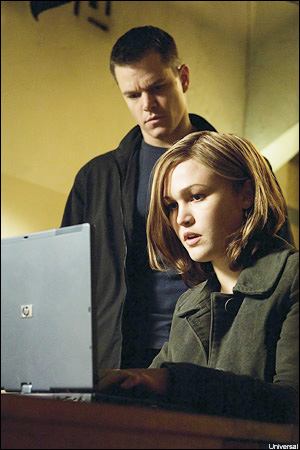
Also, Julia Stiles.
 
Julia Stiles checks her IMDB page to make sure that's her in the Bourne movies.
I remember thinking it was weird that Julia Stiles was in the first Bourne movie in a pretty inconsequential role. She was big in teen movies at the time and just seemed out of place. Then she showed up in Supremacy in a few pivotal scenes. And then she becomes super important in Ultimatum. She's all like: Hey, just hanging out 'cuz this movie seems kinda cool...yeah, I guess I'll show up for a sequel...and BOOM! major character in trilogy send off. She played a long game, and it paid off. Well, played Julia Stiles. Well played. (For the record: nothing against Julia Stiles. She's okay, I guess.)
 
One interesting thing that occured to me watching these in a row for the first time: drowning as a symbolic thread throughout. Bourne is found in the first movie, floating in the ocean nearly dead. In the second, (SPOILER ALERT), he lets go of Marie underwater. In the third, (MORE SPOILING) he is shot as he plunges into the East River. Even in the horribly misguided fourth installment, The Bourne Legacy (don't and won't own), we meet the Poor Man's Matt Damon, Jeremy Renner, underwater somewhere in Alaska or something. I'm sure there's something deep to say about how our government's secrets and lies will eventually submerge us all or something and that's what the movies are about. But I'm just an idiot watching DVDs at home, so who cares what it all means? Just kind of cool that the movies tie together that way. 
 
FWIW, ranking the films, having watched them all again, I'd go: (1) Ultimatum; (2) Identity; and (3) Supremacy. But they're all KEEPERS.
 
NEXT UP: BOWFINGER! 

Wednesday, February 20, 2013

The Man Who Knew Too Little (#27: The Bourne Identity)


When I think Sean Connery, I think Indiana Jones' dad. Needless to say, I'm not a James Bond guy. 
 
I like the spy movies which focus on the minutiae of day to day spooking, like Tinker, Tailor, Soldier, Spy or The Good Shepherd or Austin Powers. Given the choice between a conspiracy thriller like 3 Days of the Condor or an action packed globetrotter like Die Another Day, I'm taking 3 Days of the Condor every time.

All of which is a long way of saying, The Bourne Identity is my type of spy movie. But with more fight sequences.

#27: The Bourne Identity

Remember when people thought it was weird to cast Matt Damon as a lead in action movie? Yeah. That was stupid. On the upside, those people gave us this:


Damon plays Jason Bourne - which will probably be how 99% of moviegoers remember him despite great turns in everything from True Grit to The Informant. Or, at least, Damon plays a guy who is sometimes known as Jason Bourne. Washing up unconscious and bullet-ridden on a fishing boat in the Atlantic, Bourne has no memory of who he is. Following the only clue he has - a bank account number embedded in his hip - Bourne pulls a bunch of currency and stack of passports out of a safety deposit box. Soon after, he's throwing $20,000 at a stranger named Marie (the fantastic Franka Potente) to get him to Paris and away from the shadowy government agency that is chasing him. Bourne pieces a lot of it together, facing off with a retinue of great character actors (Chris Cooper, Brian Cox, Walton Goggins!*, Clive Owen, to name a few) along the way, and earns himself and Marie some small peace - at least until the sequel (NEXT UP!).

The Bourne Identity is distinctive mainly for what it doesn't rely on. Namely: CGI; crazily implausible stunts; hyperactive close-ups and smash cuts. All of which are (sadly) staples of the modern action picture. Instead (despite its fairly ridiculous amnesiac assassin premise), the movie takes a gritty, bare-knuckle, these-people-could-do-this-stuff approach. And it pays off in spades.

There's a ton of great little touches that make everything seem grounded and real. Such as Bourne ripping an emergency map off the wall to plot his exit from American embassy security or quickly surveying a road atlas and interrogating Marie on her vehicle maintenance before the world's best car chase featuring a used Mini Cooper.

The wheels are a little splashy.
In no small part, the film works due to Damon's performance. Like Harrison Ford (and Bruce Willis, when he isn't just coasting) Damon has that eery ability to simultaneously to be an in-over-his-head regular Joe and a superhuman badass killing machine without cognitive dissonance splitting your brain in half. Cementing the Harrison Ford analogy, I think this scene is the most hilariously unexpected development in an action movie since Indy shot that dude with the swords in Raiders:

  
I think its safe to say that without Jason Bourne, the Daniel Craig iteration of James Bond would have never happened. As a proud owner of a Casino Royale DVD (yes, the only Bond movie we own), I'm good with that.

FINAL VERDICT: Keeper.

*If you're not watching Justified on FX, you should. Get it together, friend.

Tuesday, February 19, 2013

It Ain't No Trip to Cleveland (#26: Bottle Rocket)

Before we begin, we must apologize to you, Dearest Reader, for the relative sparse output as of late. There are several explanations for the lag between the last post and today: (1) we're lazy; (2) we're busy; (3) Justified, Downton Abbey, The Americans, and The Walking Dead; and (4) we're lazy.

We shall endeavor to do better.

Now, back to bidness.

#26: Bottle Rocket 

Bottle Rocket stars Luke Wilson as Anthony Adams and Owen C. Wilson (yes, that's how he's credited)* as his best friend Dignan. Anthony's fresh out of a mental hospital for "exhaustion" (though as his baby sister aptly points out, it's odd that he's exhausted despite not having a job or any responsibilities). Following Dignan's 25 year plan for their future as master criminals working for Mr. Henry (casting coup James Caan), Anthony and Dignan team up with rich boy Bob Mapplethorpe# (Richard Musgrave) to knock over a book store. On the run from Johnny Law, which ain't no trip to Cleveland, they hide out in a middle of nowhere motel somewhere in Texas. There, Anthony falls in love with a housekeeper named Inez (Lumi Cavazos, charming). No spoilers, but the team disbands and heads their separate ways. That is, of course, until they reunite for (drum roll, please) one last BIG SCORE to prove their worth to Mr. Henry. And they wear awesome jumpsuits.

I gotta get me one of those jumpsuits.
When you've become used to the highly manicured full scale picture book films Wes Anderson produces these days, it is sort of a shock to watch the relatively low key goof of a heist movie he made for a debut. Sure, the DNA of what would be the Wes Anderson style is there. Emotionally stilted characters with a slightly off kilter view of the world. Meticulous attention to detail. Terrific and unexpected music choices. Characters with bizarre names like Future Man. Futura font (which unfortunately is not a font type for blogger). All the same, there is a shaggy dog sensibility to this movie and relatively "normal" characters, both of which will be excised from future Anderson films. Perhaps that's why I like it so much. It isn't too neat and perfect (which I think is a fair criticism of, say, The Life Aquatic). That little rough around the edges makes the movie both funnier and more emotionally satisfying.

I also have a pet theory that Owen Wilson, who co-wrote this, Rushmore, and The Royal Tenenbaums with Anderson, was the one who injected the "heart" and "lightness" into those movies. I like this theory because: (1) it cuts against Wilson's tabloid image as a drug-crazed sex weirdo and (2) it explains why I felt totally detached from and unmoved by The Life Aquatic and The Darjeeling Limited. I did, however, love Moonrise Kingdom and The Fantasic Mr. Fox. So maybe my theory is B.S.

Anyway, this movie is funny and charming and not nearly as stand-offish as Anderson's more recent ouevre, if you're not a fan. Check it out.

FINAL VERDICT: Keep it.

NEXT UP: The Bourne Identity, Supremacy, and Ultimatum (TRILOGY TIME, BITCHES!).

*The "C" stood for class, which he lost when he made Shanghai Knights. Oooh, BURN! (Shanghai Noon was a perfectly acceptable Western karate buddy picture but LONDON! Royalty? Disbelief no longer suspended).

#No relation to the artist. I think. Unless this is a joke I don't quite get. Which is possible.

Sunday, February 10, 2013

Cocaine is a Helluva Drug (#25: Blow)


Yes, it is, Rick James, yes it is.

#25: Blow

Blow is the true story of George Jung (no relation to Carl), the Massachusetts boy who brought Pablo Escobar's pure Colombian cocaine to our fair shores in the 1970's. Played by Johnny Depp in a succession of increasingly horrible blonde wigs, Jung lights out for Manhattan Beach, California in the late 60's with no particular plan of action; just knowing he does not want to be a sad-sack working class Joe like his dad (Ray Liotta). There, he meets Paul Reubens' Derek Foreal, the effusive owner of a hair salon for men. With Foreal's connections, Jung quickly becomes the king of pot in Manhattan Beach. From there, "Boston George" is only a short stint in federal prison with a Colombian cellmate away from (as he puts it) "a bachelor's in weed to a PHD in cocaine." Using a small fleet of private planes, Jung starts smuggling Escobar's coke to the US, making enormous amounts of money, landing a beautiful Colombian wife (Penelope Cruz), and a having a gorgeous daughter in the process. Of course, it all falls apart, as it always does.

There is an undoubted surface appeal to Blow. Director Ted Demme keeps things moves briskly, with a canny sense of the styles and moods of the decades in which the film takes place. There's also a smart refrain to the film's narration: Jung keeps describing his life in different periods of time as "perfect" - which begs the question of why the hell he didn't just stop there. Depp is in fine form, self-assured, ambitious, but vulnerable - he's good at showing a guy who is totally out of his element but wants to project complete control. And Reubens makes things interesting whenever he's on the screen.   

"Today's secret word is: benzoylmethylecgonine."
However, a second look reveals that the movie is more style than substance. And a lot of that style feels secondhand. The opening sequence showing Jung's childhood can't help but recall the beginning of GoodFellas (no doubt Liotta's presence doesn't help that impression). A later scene with a coked out Cruz flipping out in a fast-moving car also is reminiscent of the end of that flick. Of course, you can't see a movie about cocaine in the 70's/80's, especially one set in Florida for a good portion of its running time, without seeing shades of Scarface. Even the music feels cribbed. Compare:


With:


For the record, the song is "Rumble" by Link Wray. (Though I guess you can't really claim anyone "stole" from Tarantino, the master thief himself.)

So, while the movie is enjoyable, it all sort of feels like something you've seen done better before. Nor does it help that Jung - the supposed protagonist - really doesn't seem to possess any redeeming qualities, besides he says he loves his daughter a lot. We kept thinking: this guy is just clueless, self-deluded, overly-ambitious, and money-hungry. In fact, the film's saving grace could have been a bait and switch moment at the end, where you think he might get a redemptive moment, which is quickly (and rightfully) snatched away. That saving grace is undone, however, by immediately plastering a picture of George Jung's real face over the closing credits as some sort of hero.

Also dimming our enthusiasm of the movie was the knowledge that its director would die just a year after its release from a cocaine-induced heart attack. Ted Demme showed real promise with this film and the 1994 dark comedy The Ref. It's too bad.

FINAL VERDICT: Pitch it.

NEXT UP: Bottle Rocket.