Monday, February 24, 2014

How the West Was Weird (#68: Dances With Wolves)

Dances With Wolves belongs in the same sub-category of our DVD collection as The Da Vinci Code: acquisitions of uncertain provenance. We have it; we just don't know how or why that happened.

All the same, I was actually looking forward to this one. So, when we were watching Oscar winners, I suggested it as one of the entries. That suggestion was nixed by Ms. ReViewing Habit. After Last of the Mohicans inspired me to rant and rave about movies with Native American characters, I campaigned hard for it. Again, she was having none of it. Heedless, I plunged ahead on my lonesome. 

I chose poorly.


I really, really wanted to like this movie. Sure, I remember seeing it years ago and thinking it was just okay. Time, however, has not been kind to Kevin Costner's Western epic - which has become synonymous with the Oscars' habit of over-awarding actors turned directors. That it beat out (arguably) Martin Scorcese's greatest film, GoodFellas, for Best Picture makes it even worse in the eyes of many film fans. But I was hopeful I would come out of the film with a contrarian take on why the Academy got it right. Sorry to disappoint.

The buffalo stampede is the only injection of life in an otherwise terminally boring film.
Dances With Wolves commits the cardinal sin of being boring. Its story of a Civil War soldier (Costner) on the outer edges of the frontier, alone, by choice, confronted with the harsh realities of nature and the uncertainty of natives that regard him with suspicion, shouldn't be boring. But it feels endless and pointless.

The shame is that there is a deeper, weirder movie here struggling to bubble to surface. The opening sequence, where Costner's character survives a battle with his leg intact only because the surgeon needs a cup of coffee before sawing it off, told in fuzzy POV, sets an off-kilter tone. That is quickly followed by an odd setpiece with a Major (Maury Chaykin), soaked to his gills, referring to Costner's Lieutenant as "Sir Knight" and speaking of "quests" before offing himself which is (dare I say it?) Apocalypse Now-like in its threatening ambiguity. Then there's Mary McDonnell's alternately fascinating and cringe-inducing performance as Stands With A Fist, a refugee of the white world and a character of uncertain mental stability. A half hour in, I'm excited about what this movie might have to say about the senselessness of war, about man and nature, about our yen to be somewhere new and to hold on to somewhere old.

But Costner's paint-by-numbers direction and strangely lifeless performance and narration quickly suck any ambiguity or nuance out of the proceedings. The movie is ultimately too old-fashioned, and the usually charismatic Costner too restrained, to be interesting or effective. Did I mention it was boring?

It's honestly the first of the films we gave up on before it was over. If I'm not hooked after 2 hours, what's the point of continuing? We have other DVDs to watch.

FINAL VERDICT: PITCH

NEXT UP: STARDUST

Wednesday, February 12, 2014

We Were There (#67: The Last of the Mohicans)

Growing up, didn't it seem like you always covered the same topics in history? Every year, you learned about Jamestown, the Mayflower, the first Thanksgiving, then you'd get to the American Revolution and (maybe) the War of 1812 and stop. The rest was left for high school, we guess, though we picked up most of it on our own (and that most of what we had learned was more folklore than history) from the History Channel or by watching too many movies. 
 
It's always seemed weird, then, that there are so few films about pre-Civil War America. Or, for that matter, pre-America America. Sure, we remember watching the Johnny Tremain Disney movie and way too many Daniel Boone VHS tapes as a kid. But with all the force-feeding of creation myths in schools, where is our cinematic propaganda? Where's the treacly George Washington biopic bathing his apocryphal cherry-tree chopping in a magic hour halo of light and a John Williams score?
 
In all seriousness, there's a rich vein of American (and Native American) history left unportrayed on film. Which is a shame.


Michael Mann did his part to fill the void with The Last of the Mohicans. Adapted from James Fenimore Cooper's classic (but slightly arduous for modern readers) Leatherstocking Tales, this is the story of Hawkeye (Daniel Day-Lewis) the adopted European son of Chingachgook (Russell Means), the titular last of the Mohican tribe. Hawkeye does his best to stay out of the turf battle between the British and French taking place in and around his upstate New York  trapping grounds (a little tete-a-tete later called the French and Indian War). But when Cora Munro (Madeleine Stowe), the gutsy daughter of a British general, needs an escort to her father's camp, he volunteers. When the escort party ends up mostly slaughtered and Cora kidnapped by Magua (Wes Studi), the nefarious Huron allied with the French, he vows to find her. Guess how it ends?
 
Wildly romantic and lushly shot, Mohicans is filled with the grandeur and adventure that can only be mustered by classic Hollywood epics. It's quite a departure from the rest of Mann's oeuvre, which is mostly filled with chilly, slow burn crime thrillers with one word titles (Manhunt, Thief, Heat, Collateral). In researching this review (yes, we do research!), we discovered that the 1936 version is the first movie Mann can remember watching. Clearly a passion project for the director, the movie bursts with nostalgia: from the swelling score to the gorgeous landscape, everything feels like a film memory the first time you see it.
 
Needless to say, Day-Lewis is fantastic. His sardonic intensity and dangerous physicality are perfect for the enigmatic Hawkeye. Madeleine Stowe is an ideal Jane to his Tarzan: sharp and daring. Means and Studi make you wonder why Hollywood didn't crank out Native American epics every single year in the 90's, as they had two readymade stars executing in top form. 
 
We're not qualified enough to opine on whether the film's treatment of the lives and dynamics between the different groups (Natives, colonists, foreign military) is truly accurate. To that end, we're not sure the ending, with Means solemnly intoning about the loss of his way of life and all the characters' ways of life, is truly earned. But with that glorious view of unspoiled wilderness and manipulative underscoring, it sure feels like it.
 
FINAL VERDICT: KEEPER
 
NEXT UP: DANCES WITH WOLVES

Monday, February 10, 2014

We Can Smell It (#66: The Rock)

A wise person once said that there are two types of people in the world: Nicolas Cage fans and liars.


We qualify as both.

#66: The Rock

The Rock stands for everything we hate about modern Hollywood action: gleefully illogical plotting; one-note/full-volume characterization; melodramatic nationalism; shameless product placement; and frenetic close ups as far as the eye can see. Throw in a few more lens flares and you have a recipe for ReViewing Habit hater-ade.
 
But, goddamn it, The Rock works.
 
No, we don't believe for a single second that Ed Harris and David Morse could so easily swindle a rare deadly gas, arm rockets, and take over Alcatraz. (By the way, you should totally check out the Alcatraz tour if you're ever in San Francisco, it's really cool. Even without Nicolas Cage. Though adding Cage to the cages [groan!] would be a coupe de grace.)
 
No, I don't buy that the lowly FBI bomb detonator played by Cage (with the uber-ridiculous handle of Stanley Goodspeed) would be sent into such a dangerous mission with hardly any real field training.
 
Moreover, would the real Michael Biehn (Commander Anderson), were he in charge of such a mission, allow a liability like Goodspeed to come along? No way. Amiright, sexy '80's Michael Biehn?
 
Yes. Yes, you are.
On the other hand, we totally buy that an aging and likely entropied British spy (Sean Connery) would not only have the werewithal to break back into Alcatraz and kick Army dude ass after 30 years behind bars, but also ESCAPE his FBI entourage and steal (and namecheck!) a Humvee. Yes, a HUMVEE! HOW DOES HE EVEN KNOW WHAT A HUMVEE IS? HE WAS IN JAIL SINCE THE SIXTIES! HUMVEES WEREN'T A THING UNTIL THE 80'S! WHAT IS HAPPENING?!?!?!
 
That "what on earth is happening?" vibe - epitomized, of course, by a trademark gooftactular Cage perfomance - is what makes it all work. The Rock is so breathless in its craziness, you can't help but get caught up.
 
But maybe we're weak...we do have a soft spot for the Cage.
 
 
FINAL VERDICT: KEEPER
 
NEXT UP: THE LAST OF THE MOHICANS


Sunday, January 26, 2014

You're Thinking and Explaining Again (#65: The Da Vinci Code)

So, when we fell off the Best Picture wagon, we fell hard. Inspired by the looming threat of winter storm and maybe one too many Yuengling Lights, we decided to throw The Da Vinci Code into the DVD player and see if it was bad was we remembered.
 
 
Surprise! The answer is yes! It's awful. Jawdroppingly, how-did-this-happen awful?
 
(Sidenote: We have no idea how we came to own this DVD.)
 
On paper, this movie looks great. Adapted from Dan Brown's mega-selling page turner, directed with typical workmanlike efficiency by Ron Howard, starring the fantastic Audrey Tautou, Ian McKellan (in a role that lets him play in his impish British gentleman wheelhouse), and America's favorite leading man, Tom Hanks. What could go wrong?
 
For starters, all the weaknesses of Brown's writing are exposed on film. Brown is a master plotter and the book unfolds with relentless urgency; any dead spots brightened up by the puzzle after puzzle for the reader to work through. The wooden prose and silly conspiracy stuff doesn't even matter because we are racing to find out what happens next. But the film viewer doesn't get the satisfaction of seeing and working through the puzzles for themselves - at least not in this script. What we're left with is a lot of watching other people sit around, thinking out loud, and explaining things.
 
That can work with the right characters (have you seen any Richard Linklater film?). But not here. Robert Langdon was a bland facsimile of Indiana Jones without the whip on paper, and he's even less than that here. Hanks gets almost nothing to work with. It feels like he has less than 25% of the dialogue and mostly then just to express surprise at what he's being told. And he gets told a lot of stuff. And a lot of what he's told thuds as expositorily as an entry level religious studies lecture.
 
What was a catch-your-breath whodunit on paper thus becomes a when-does-this-thing-end quasi-history lesson on film.
 
And we really, who in god's name forced Tom Hanks to do that to his head? The man is living icon. FOR SHAME!
 
 
Don't even get me started on Paul Bettany.
 
FINAL VERDICT: PITCH

Here Endeth the Lesson (#64: The Untouchables)

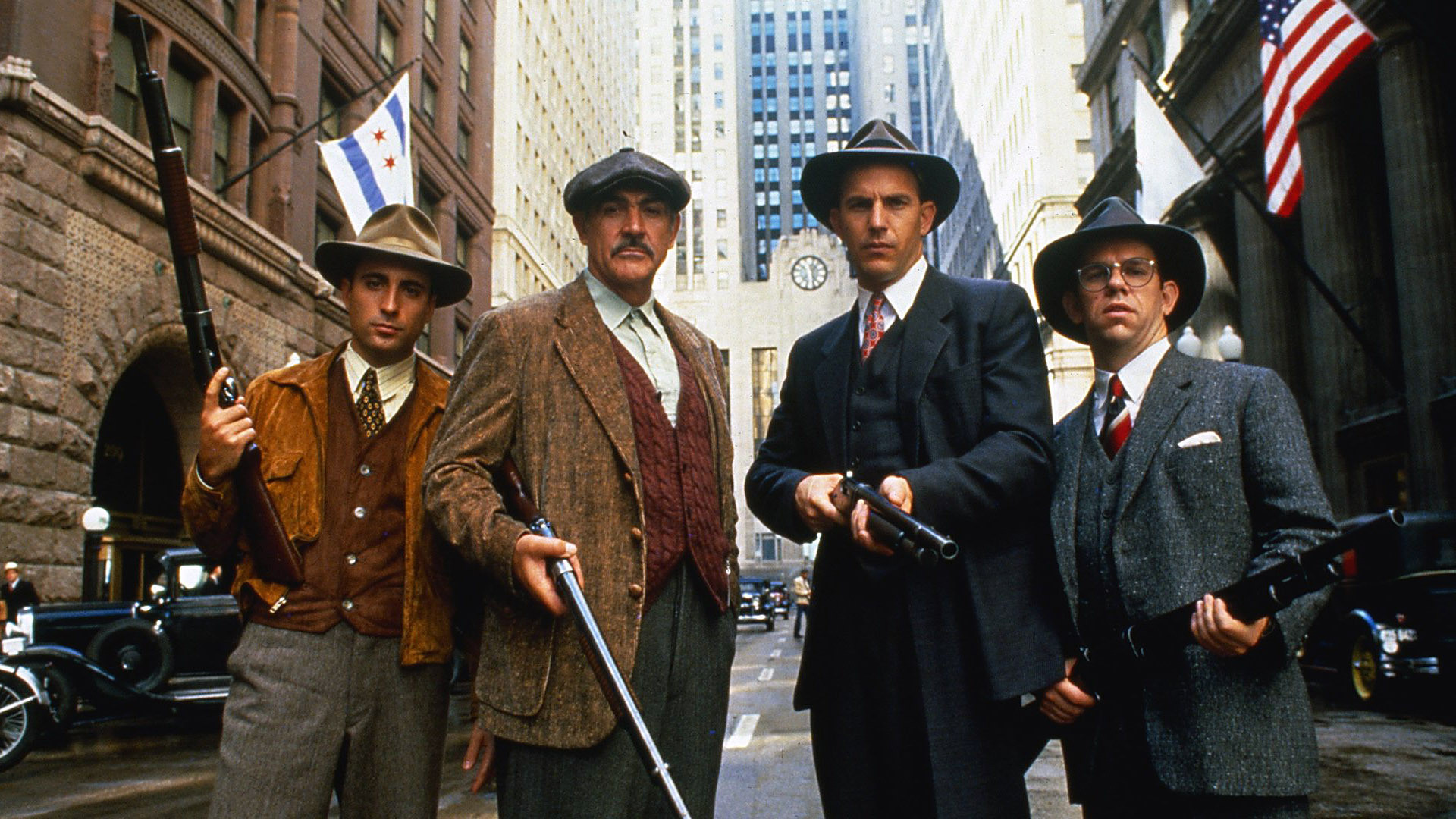
OK, so maybe the plan was to watch only Best Picture winners for a while. But then Andy Garcia in Godfather, Part III happened, which can only, inexorably lead to one conclusion: WATCH THE UNTOUCHABLES.
 

Welcome to Chicago.

While The Untouchables did take home an Oscar for Best Supporting Actor (Sean Connery), it was not a best picture nominee. Be that as it may, The Untouchables is a classic of the gangster film genre, made all the better for having actual protagonists - Eliot Ness (Kevin Costner) and his gang of "untouchable" super-cops. Sure, Robert DeNiro chews his share of scenery as Al Capone - and to great effect. But this is the rare modern gangster film with the gumshoes and cheap suits as the stars and not just cannon fodder.

Directed by that underrated auteur Brian DePalma, The Untouchables tells the story of how Eliot Ness handcrafted a delicious amber lager on the shores of Lake Erie. Actually, no, it's about the Treasury Department's full throttle push to take down infamous Chicago ganglord Capone. Ness assembles a crack team: a streetwise Irish beat cop (Connery); a nebbishy accountant (Charles Martin Smith); and a hotheaded rookie (Garcia). Together, they declare all-out war on Capone and see plenty of casualties along the way, all rendered in thrilling and anxiety-producing detail with DePalma's steady hand behind the camera.
 
Many of the set pieces in this film are so iconic, you may know them already, even if you've never seen it. 
 
 
Fantastic direction and crackling performances asides, my favorite thing about this film might be the part they couldn't make up. Ultimately, what got Capone? Failure to pay taxes. That's the thing about criminals. No matter how powerful and rich they become, they tend to get caught because they're not smart enough to tend to the little things.
 
FINAL VERDICT: KEEPER
 
NEXT UP: THE DA VINCI CODE

Monday, January 20, 2014

I Broke My Heart (#61-63: The Godfather Trilogy)

When we decided to focus on some best picture winners, we had to do a bit of work figuring out which we had. Scanning the results, the choice for next in the queue was obvious: The Godfather. Since we own a box set of the trilogy, that meant watching them all. (Ironic "darn" and shake of fist).
 
The Godfather waltzed to a Best Picture win in 1972, beating out Cabaret, Deliverance, The Emigrants, and Sounder. Of those, only Deliverance has any kind of lasting cultural cache and then mostly as a banjo-sound-effect joke.  Marlon Brando also took home a li'l golden guy for his iconic performance as Vito Corleone...er, or he would have, had he not famously refused it to protest the treatment of Native Americans:
 
 
The imaginatively titled The Godfather, Part II  prevailed in the face of stiffer competition in 1974: classics such as Chinatown, The Conversation, and Lenny (featuring an incredible Dustin Hoffman performance) were in that field, with The Towering Inferno also nominated. In what I think is the only occassion of two actors winning Oscars for the same role, Robert DeNiro also won Best Supporting Actor for his performance as Vito as a young man. DeNiro, 31, and just breaking out after terrific performances im Bang the Drum Slowly and Mean Streets, kept his Oscar.
 
Despite its reputation as the redheaded stepchild of the trilogy, The Godfather, Part III, was also nominated for Best Picture. It lost to Dances With Wolves in 1990, which famously upset the far superior and inarguably better GoodFellas. Awakenings (good year for DeNiro!) and Ghost were also nominated that year. Nominated for 7 Oscars, Godfather 3 took home none (ANDY GARCIA WUZ ROBBED!). It did get some accolades: Sofia Coppola won two Razzies for Worst Supporting Actress and Worst Newcomer.
 
But this isn't all about awards...let's get to the movies. Typically, we take these movies one at a time but let's consider this two-part opera, and its underrated denouement, together as a whole below the jump.

Saturday, January 18, 2014

Missing the War (#60: The Hurt Locker)

Inspired by the announcement of the Academy Award nominees the other day, we decided to peruse our collection for former Best Picture winners. As it turns out, we've already reviewed a few: Casablanca (1943), The Departed (2006), and  No Country for Old Men (2007). Each of those keepers were also probably the rightful winner their year. I seem to remember The Departed being a bit of a surprise win at the time, but, in retrospect, its competitors (Babel, Letters from Iwo Jima, The Queen, and Little Miss Sunshine) are fairly weak tea. You could make an argument that There Will Be Blood should have prevailed over No Country in 2007, but we prefer the latter (Juno, Michael Clayton, and Atonement were the other nominees that year). Since we have already covered the 2006 and 2007 winners, why not march on to 2008? Because we don't own the overrated Slumdog Millionaire!
 
So, fast forward to 2009. The year when the Academy (wisely) expanded the field to as many as 10 films. While that allowed in cliche-ridden stinkers like The Blind Side and Precious and the big-moneyed but little-brained Avatar into the big dance, those questionable choices joined the company of some damn good films: District 9, An Education, A Serious Man, Up, Up in the Air, Inglourious Basterds, and the winner...
 
#60: The Hurt Locker


You could make an argument in favor of several of these films as the Best Pic. Personally, we pulled for Inglourious Basterds in that race - arguably, Tarantino's finest film (we'll get there!). Pixar has yet to match the transcendant Up, which was a classic upon arrival. A Serious Man is seriously underrated in the Coen Brothers ouevre. And District 9 actually reignited a moribund genre (sci-fi), unlike its big brother Avatar, which has inspired far fewer imitators. But it's hard to fault the Academy's choice of The Hurt Locker, Kathryn Bigelow's searing portrait of an explosive detonation unit in the Iraq War.
 
It's an odd sort of war film in that the actual running time dedicated to combat qua combat is limited. The bomb squad is called in, typically, after the battle is over or before anything happens - either to clear the way or to clean up the mess. The action for these soldiers instead requires the tortuous patience to cut wires and unbury IEDs while wearing the equivalent of a space suit. 
 
The unbelievable task at hand for this unit makes for fascinating and tense cinema. While, at times, the focus on the detonations can also make the movie feel like nothing more than a series of well-constructed vignettes, Bigelow and screenwriter Mark Boal are playing a deeper game. Quietly, the film builds into a character study of an inscrutable character, Sergeant First Class William James. (Jeremy Renner, in a career-making performance, has never been better than here.* His co-stars, Anthony Mackie and Brian Geraghty, are also excellent.) 
 
The question the film (and Renner's performance) asks: what kind of man can wear that suit and how can he survive outside of a war? It is really only interested in that question - eschewing much dialogue about the war and its purposes (or lack thereof), the focus remains on James and his men. Cannily, big name actors (Guy Pearce and Ralph Fiennes) are introduced and quickly dismissed, ratcheting back the focus to the then-unknown Renner - forcing the audience to ask themselves: who is this guy?
 
In fact, I think the only misstep in the whole film is James' excursion off the base to find the family of an Iraqi boy he believes has been murdered. While it tells us something about James, its more about the boy - and feels tonally askew as a result. But ultimately, devastatingly, the film zooms back on its target.The scene of James standing in the mundane opulence of a stateside supermarket, staring blankly at row after row of hypercolor cereal boxes, says it all without saying a thing. What does war do to a man? And what is that man do without a war?
 
FINAL VERDICT: KEEPER
 
NEXT UP: THE GODFATHER TRILOGY (2/3 for Best Picture Oscars)

*He may be better (but overlooked due to his showier castmates) in Amercian Hustle.